In preparing my aesthetic statement for my master thesis, I had to pull together the works of literature (and elsewhere) that have inspired me to be the writer I am becoming. In pulling together a book list and some quotes, I came up with more than I needed. Here are some quotes from books I just loved and had to share. So indulge me…
 Dr. Wayne Dyer’s book, Inspiration: Your Ultimate Calling, has had a profound effect on me in the last six years. Dyer talks at length about how getting inspired means being in-Spirit with your Source. Here are a couple of great quotes that didn’t make it into my edited essay.
There’s a voice in the universe entreating us to remember our purpose, our reason for being here now in this world of impermanence. The voice whispers, shouts, and sings to us that this experience – of being in form in space and time – has meaning. That voice belongs to inspiration, which is within each and every one of us.
Before merging into form, we were a part of God, with all the inherent qualities of a Creator who sends forth abundance, creativity, love, peace, joy, and well-being.
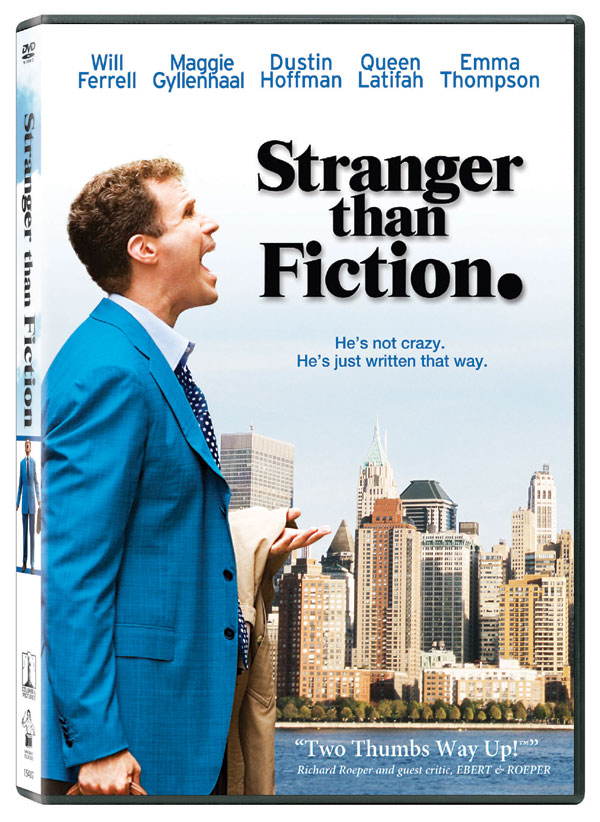
 The movie and screenplay for Stranger than Fiction is for me a work of art. In the screenwriter, Zach Helm uses vocabulary and words in a vastly creative outlet. On top of that, is this strange story of a writer who can’t find her inspiration and an IRS agent who can’t find his. Here are some of the greats from the screenplay:
Harold Crick: I brought you flours.
Ana Pascal: [seeing the sweetness of the gesture, then realizing he’s carried 10 bags of flours] Um… and you carried them all the way here?
Harold Crick: Miss Pascal, I’ve been odd, and I, I know I’ve been odd, and… I want you.
Ana Pascal: What?
Harold Crick: There are many reasons, there are so many influences in my life, that are telling me, at times, quite literally, that I should come here and bring you these, but I’m doing this because I want you.
*****
Kay Eiffel: Because it’s a book about a man who doesn’t know he’s about to die. And then dies. But if a man does know he’s about to die and dies anyway. Dies- dies willingly, knowing that he could stop it, then- I mean, isn’t that the type of man who you want to keep alive?
*****
Kay Eiffel: As Harold took a bite of Bavarian sugar cookie, he finally felt as if everything was going to be ok. Sometimes, when we lose ourselves in fear and despair, in routine and constancy, in hopelessness and tragedy, we can thank God for Bavarian sugar cookies. And, fortunately, when there aren’t any cookies, we can still find reassurance in a familiar hand on our skin, or a kind and loving gesture, or subtle encouragement, or a loving embrace, or an offer of comfort, not to mention hospital gurneys and nose plugs, an uneaten Danish, soft-spoken secrets, and Fender Stratocasters, and maybe the occasional piece of fiction. And we must remember that all these things, the nuances, the anomalies, the subtleties, which we assume only accessorize our days, are effective for a much larger and nobler cause. They are here to save our lives. I know the idea seems strange, but I also know that it just so happens to be true. And, so it was, a wristwatch saved Harold Crick.
 Nick Hornby’s About a Boy follows much of the same themes as Stranger than Fiction. Hornby uses humor in tragic tales much the way a later author on this list does. About a Boy remains my favorite Hornby book. Here are a couple of highlights from the book:
Loving people, and allowing yourself to be loved, was only worth the risk if the odds were in your favor, but they quite clearly weren’t. There were about seventy-nine squillion people in the world, and if you were very lucky, you would end up being loved by fifteen or twenty of them. So how smart did you have to be to work out that it just wasn’t worth the risk?
No man is an island…
But all three of them had to lose things in order to gain other things. Will had lost his shell and his cool and his distance, and he felt scared and vulnerable, but he got to be with Rachel; and Fiona had lost a big chunk of Marcus, and she got to stay away from the casualty ward; and Marcus had lost himself, and got to walk home from school with his shoes on.
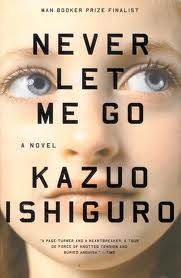
 Never Let Me Go by Kazuo Ishiguro is one of the best books I have read in a long time. It really stayed with me long after reading it (Click here to read more about my opinion of the book). While you have to read it to really appreciate its effect, here are some of the best quotes:
A lost corner. That’s what she called it, and that was what started it. Because at Hailsham, we had our own “Lost Corner” up on the third floor, where the lost property was kept; if you lost or found anything, that’s where you went. Someone – I can’t remember who it was – claimed after the lesson that what Miss Emily had said was that Norfolk was England’s “lost corner,” where all the lost property found in the country ended up. Somehow this idea caught on and soon had become accepted fact virtually throughout our entire year.
I keep thinking about this river somewhere, with the water moving really fast. And these two people in the water, trying to hold onto each other, holding on as hard as they can, but in the end it’s just too much. The current’s too strong. They’ve got to let go, drift apart. That’s how it is with us. It’s a shame, Kath, because we’ve loved each other all our lives. But in the end, we can’t stay together forever.
When we lost something precious, and we’d looked and looked and still couldn’t find it, then we didn’t have to be completely heartbroken. We still had that last bit of comfort, thinking one day, when we grow up, and we were free to travel around the country, we would always go and find it in Norfolk…And that’s why years and years later, that day Tommy and I found another copy of that lost tape of mine in a town on the Norfolk coast, we didn’t just think it pretty funny; we both felt deep down some tug, some old wish to believe again in something that was once close to our hearts.
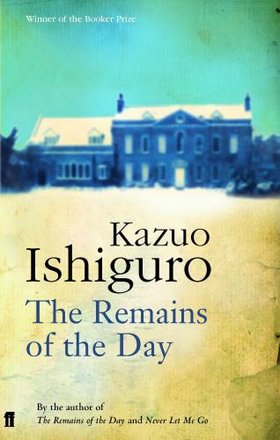
Another one of my favorites is also by Ishiguro, The Remains of the Day. 
What is the point of worrying oneself too much about what one could or could not have done to control the course one’s life took? Surely it is enough that the likes of you and I at least try to make our small contribution count for something true and worthy. And if some of us are prepared to sacrifice much in life in order to pursue such aspirations, surely that in itself, whatever the outcome, cause for pride and contentment.
As I say, I have never in all these years thought of the matter in quite this way; but then it is perhaps in the nature of coming away on a trip such as this that one is prompted towards such surprising new perspectives on topics one imagined one had long ago thought thoroughly.
He chose a certain path in life, it proved to be a misguided one, but there, he chose it, he can say that at least. As for myself, I cannot even claim that. You see, I trusted. I trusted in his lorship’s wisdom. All those years I served him, I trusted I was doing something worthwhile. I can’t even say I made my own mistakes. Really – one has to ask oneself – what dignity is there in that?
 Anne Tyler has been a long-time favorite. My favorite of hers remains The Accidental Tourist. Like Hornby,Tyler takes quirky characters in the midst of tragedy and adds that small dash of humor and hope. Two of my favorite moments in the book involveMacon’s willingness to accept the new people in his life. In the end, he leaves behind his old life and self for Muriel and much earlier in the book he accepts her son, Alexander, after seeing him being bullied on the walk home from school. The book boils down to this one great quote:
I’m beginning to think that maybe it’s not just how much you love someone. Maybe what matters is who you are when you’re with them.
 Lastly, we come to Anne Morrow Lindbergh’s opus to the life and the sea, Gift from the Sea. Second only to the bible for me, this book shapes and reshapes my view of self, the world and country. It is a great collection. Here is a limited (I really tried) collection of treasures from this book:
I do not believe that sheer suffering teaches. If suffering alone taught, all the world would be wise, since everyone suffers. To suffering must be added mourning, understanding, patience, love, openness, and the willingness to remain vulnerable.
When you love someone, you do not love them all the time, in exactly the same way, from moment to moment. It is an impossibility. It is even a lie to pretend to. And yet this is exactly what most of us demand. We have so little faith in the ebb and flow of life, of love, of relationships. We leap at the flow of the tide and resist in terror its ebb. We are afraid it will never return. We insist on permanency, on duration, on continuity…The only real security is not in owning or possessing, not in demanding or expecting, not in hoping, even. Security in a relationship lies neither in looking back to what was in nostalgia, nor forward to what it might be in dread or anticipation, but living in the present relationship and accepting it as it is now. Relationships must be like islands, one must accept them for what they are here and now, within their limits – islands, surrounded and interrupted by the sea, and continually visited and abandoned by the tides.
This is what one thirsts for, I realize, after the smallness of the day, of work, of details, of intimacy – even of communication, one thirsts for the magnitude and universality of a night full of stars, pouring into one like a fresh tide.
This last one by Lindbergh opens Life in Harmony.
Simplicity of living, as much as possible, to retain a true awareness of life. Balance of physical, intellectual, and spiritual life. Work without pressure. Space for significance and beauty. Time for solitude and sharing. Closeness to nature to strengthen understanding and faith in the intermittency of life: life of the spirit, creative life, and the life of human relationships.









 B. K. Bergman